Every incident is an opportunity to improve.
Capture incidents and near misses while the details are still fresh, investigate what contributed to them, and turn what you learn into accountable follow-up. Simple Safety Coach keeps reporting, investigation, corrective-action work, and recordkeeping connected.
Understand what happened-and what can be learned from it.
An incident report should be the beginning of the learning process, not the end of it. Conditions, decisions, equipment, training, communication, procedures, and other contributing factors can all help explain why an event occurred. SSC gives Safety Managers a structured place to bring that information together and investigate without reducing the process to finding someone to blame.
Report incidents and near misses from the field-even when you're offline.
Employees can start an Incident or Near Miss report from the SSC mobile app while the event and surrounding conditions are still fresh. Mobile reporting can be completed online or offline, so a poor connection doesn't have to delay the initial report.
- Submit Incident and Near Miss reports from the browser or mobile app
- Use the mobile reporting workflow online or offline
- Capture important event details while they are still readily available
- Add photos and supporting information to help document what occurred
- Continue management, investigation, and follow-up in SSC after the initial report
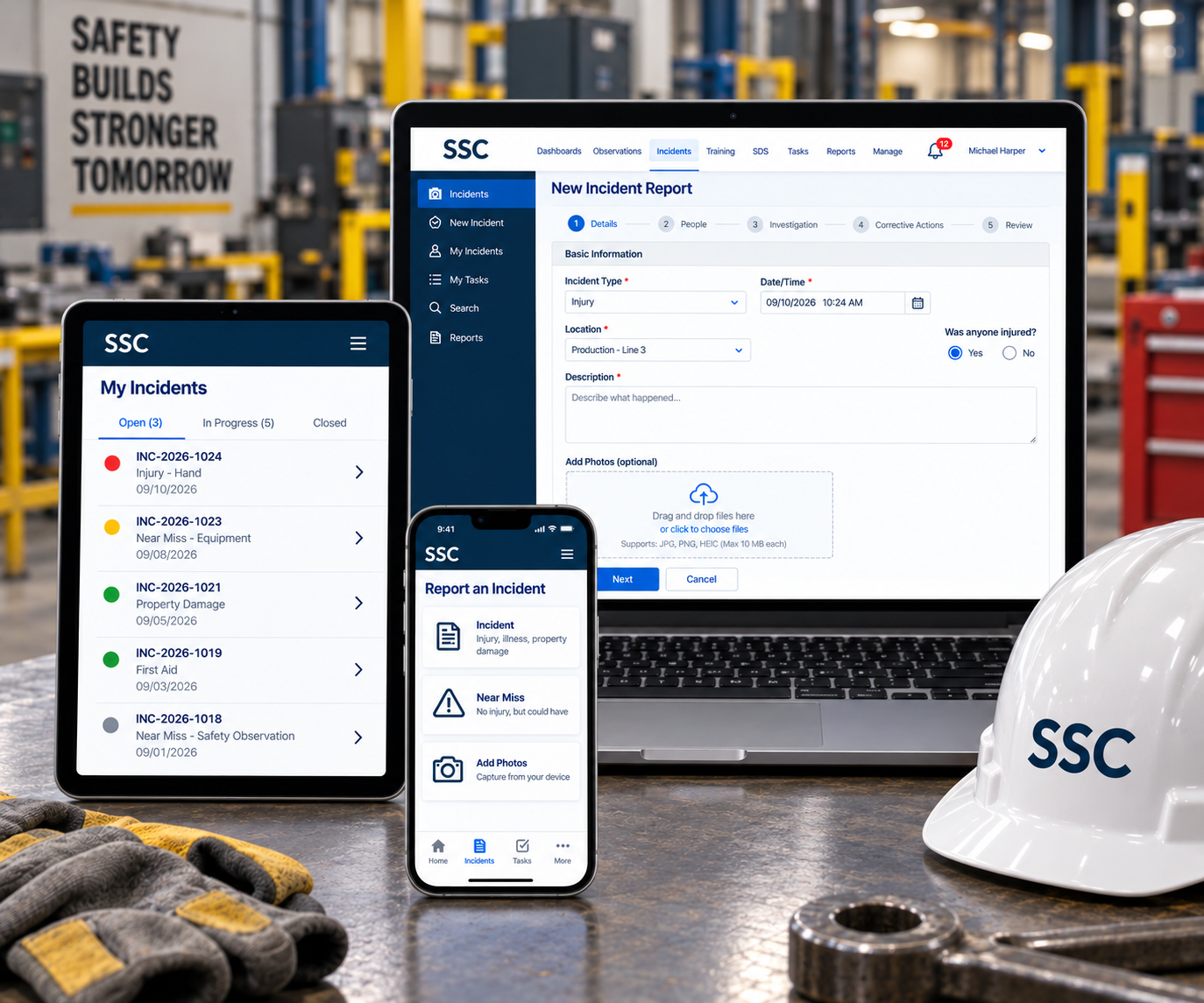
Keep the entire incident-management process connected.
The original report is only one part of the record. SSC helps keep the information needed to understand the event, determine appropriate follow-up, and document what happens next together in one workflow.
Report
Capture the incident or near miss promptly, including the people, location, circumstances, and supporting information.
Investigate
Document the investigation, Immediate Cause, contributing factors, root causes, witness information, and other evidence.
Act
Define corrective actions and assign SSC Tasks to the people responsible for completing the required follow-up.
Learn
Use completed incident information in reporting and trend analysis to help identify recurring concerns and opportunities to improve.
Manage supporting attachments as the investigation develops.
The information available during management and investigation often goes beyond what was known when the initial report was submitted. SSC allows supporting attachments to remain with the Incident record, keeping relevant evidence and documentation connected to the event rather than scattered across email and shared drives.
Assign Tasks for corrective actions.
Identifying a corrective action is only useful if someone is responsible for carrying it out. Corrective actions identified through the Incident Management process can be assigned as SSC Tasks, giving the responsible employee a clear assignment and giving management visibility into the work that needs to be completed.
Keep OSHA recordkeeping connected to the incident information behind it.
When an event is OSHA-recordable, SSC can use the incident information already captured in the system to support OSHA 300, 301, and 300A reporting. That keeps compliance reporting connected to the underlying incident record while allowing the investigation itself to remain focused on learning and improvement.
Look across incidents for patterns that deserve attention.
A single incident tells you what happened once. Consistent incident information over time can reveal recurring event types, causes, locations, or other patterns that are harder to see one report at a time. SSC reporting helps Safety Managers use that history to decide where deeper attention, training, process changes, or other prevention efforts may be warranted.